It’s seems like a dream when I realize that my time with Peace Corps Dominican Republic is over. I’ll be back in Pennsylvania for the summer on May 24. And who knew that leaving was going to be the hardest part?
We spent our last few months finishing up our latrine project. Here are a few photos. The school kids helped me paint a mural of Hispaniola. We played with our cats. We harvested a lot of lettuce and radishes from our garden. We hiked Pico Duarte, the highest peak in the Caribbean. I spent a few days hiking through the national park Valle Nuevo that connects our province, San José de Ocoa, with Constanza, the high mountain valley to our north that produces such wonderful, but un-Caribbean produce like apples, strawberries, cabbage, and broccoli. And of course we spent a lot of time just trying to savor the last few weeks in our peaceful shack surrounded by wonderful neighbors, clever kitties, and verdant lush mountains. And now it’s over.
We also traveled to visit several other volunteers’ communities. The DR continues to astound me with its biodiversity. We visited a batey in the southwest. Batey’s are small communities where agricultural workers live in close proximity. They spring up around sugar-cane, coffee and cacao plantations. Some bateys only have inhabitants during harvest time, while others have become permanent communities. Traditionally bateys were filled with migrant Haitian workers. But in many cases a lot of those migrant Haitians just stayed so that several generations later these bateys have become small communities of mostly Spanish-speaking people of Haitian descent. This was the case for the batey that we visited. The people in the bateys still subsist off of working on large agricultural plantations, and in the south this consists mostly of working in the sugar-cane fields. The culture and cuisine of the bateys have distinct Haitian influences. The most important food influences, to me at least, are the Haitian bread called biskwi, and the (often spicy) peanut butter called mamba. While in the southwest we also visited the town of Los Rios beside Lago Enriquillo, a salt lake approximately the size of Manhattan. Unfortunately for the farmers surrounding the lake, the lake’s water level keeps rising at a substantial rate engulfing dozens of acres of farmland each year. Deforestation in the Sierra de Neyba plays a large part in the rising water level. Fewer trees mean that the soil cannot absorb as much rainwater thus much more runoff ends up in the rivers that feed Lago Enriquillo. We also visited Los Guineos in the northeast where a fellow volunteer is working on a kayak tourism project on Laguna Limon, a large freshwater lake that occasionally overflows into the Atlantic Ocean just outside of Samaná Bay. From there we took a boat north across Samaná Bay to Samaná Peninsula and visited a few of the most beautiful beaches that I’ve ever seen.
After completing my service I also spent a few days in Haiti. It was very interesting to see the other side of the island. Here are some photos. The DR and Haiti have much shared history and geography, and yet they’ve turned out, so far, very differently. About 27 percent of the DR remains forested while Haiti has only about 1 percent forest cover. This has huge ramifications on things as far-ranging as soil erosion, amount of rainfall, soil quality, and hydroelectricity potential. In terms of development, even when accounting for all the damage caused by the 2010 earthquake, Haiti is a long way behind the Dominican Republic. This is even harder to understand when you realize that at the end of the eighteenth century Haiti was the richest colony in the Americas. Today it’s one of the poorest countries in the entire Western Hemisphere. I have been fascinated with the question of why the two countries, they share the same island after all, have turned out so differently. My visit was partly a continuation of my quest to understand how two countries on one island can have such distinct outcomes.
I didn’t really know what to expect when I signed up for Peace Corps. I knew that I’d be living in a foreign country for two years, and that was enough. But Peace Corps for me has been so much more than just 27 months on an exotic, unimaginably beautiful subtropical island. Like all unique experiences, it’s very difficult to put into words. If I had to pick one single most important thing that I’m taking away from Peace Corps, I would probably choose the perspective on life that it’s given me. Being part of a close-knit community for two years not only taught me about cross-cultural relations, but it also taught me a lot about how communities in general function. The world is big and very complex, much more so than most people believe. What makes perfect sense to you might make no sense at all to someone from a different culture, and like it or not, that’s just the way it is. Open-mindedness, patience, and adaptability are some of the most crucial skills in surviving and working in a foreign culture. Some cultural differences are fun, some are quaint and amusing, and some are just plain infuriating. But, for the most part, they are almost impossible to change. But it's amazing how much more sense all of the differences make when,through living their lifestyle, you try to see the world through the eyes of people from a foreign culture.
Peace Corps has taught me to value friendship more. It has taught me that individuals, as opposed to their environment, can often be the limiting factor in trying to achieve their dreams. I deal better with failure. I can relax more when things are out of my control.
As sad as I am to leave I will not miss LOUD music (I’m pretty sure that I’ve experienced hearing loss), the it-will-eventually-happen attitude which makes everything take 10 times as long as it should, blatant animal and child abuse, the culture of procrastination, and lack of waste management.
I will however miss neighbor kids who pop in to visit at any hour, the view from our kitchen window, the freedom to take siestas almost whenever I want, colmados, free lunch at any doña’s house when I visit over noontime, the culture of sharing, Peace Corps friends, public transport that can take you anywhere in the country, and just generally La Gran Libertad of this crazy island where pretty much everything goes.
It has truly been an incredible life-changing adventure. Thanks for sharing it with us.
-Leon
Showing posts with label beach. Show all posts
Showing posts with label beach. Show all posts
Sunday, May 20, 2012

Friday, July 22, 2011
Summertime
Summer is bounding by and I have been too busy (and too much of a procrastinator) to update my blog for a while. Here’s what we’ve been up to in the last two months. As far as work goes we’re still working on building a few more latrines, as well as waiting to see if we get more funds donated. I am also in the process of trying to organize a group of coffee farmers in my community to get together and start a large coffee nursery, but that project is still formulating so it makes for rather boring talk and even more boring photos.
In June we started painting a map mural on the wall of the local school. That has been great fun and the some of the neighborhood kids have really enjoyed practicing their drawing and painting skills. Check out the photos. The only real problem has been that the night watchman of the school leaves to work in his fields early in the morning. This in itself is not a problem because he can leave the keys at a neighbor’s house. And he sometimes does, but other times we’ll walk the 20 minutes to school only to find out that the watchman carried off the keys so we have no other choice but to walk back home. I have talked to him many times about this and in typical Dominican fashion he is very agreeable and promises to leave the keys the following morning. But as so many of us volunteers have learned, there is often a big difference here between what you say and what you do. People mean well, but they often have a mindset like the man who recently chided me when I was in a hurry, “Life is short, slow down and enjoy it.” This, I’ve recently realized, is one of the reasons the DR is such a wonderful place in which to play and travel. But when it comes to organizing work projects, expect your share of setbacks and headaches.
Early July was a rather difficult time as our wonderful cat Schnickelfritz died of apparent poisoning. I know that various neighbors put out rat poison and he must have found something contaminated. It was a sad day. On a brighter note, about a week before this a starved little kitty showed up at our house one morning and, after we gave it some food, moved in with us. We christened him Clunkers because the name seemed to suit his ratty condition. The neighbor kids called him ratoncito (little mouse) for a few days.
Over the fourth of July we went hiking in the Cordillera Central and then spent a day in the beautiful valley of Constanza. Enjoy the photos.
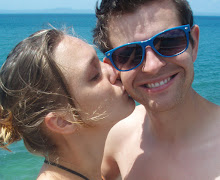
Also Anna’s parents came to visit the past two weeks. We had a wonderful time introducing them to our communities and then spent a few fabulous days at a beautiful beach. Just check out the pictures.
In June we started painting a map mural on the wall of the local school. That has been great fun and the some of the neighborhood kids have really enjoyed practicing their drawing and painting skills. Check out the photos. The only real problem has been that the night watchman of the school leaves to work in his fields early in the morning. This in itself is not a problem because he can leave the keys at a neighbor’s house. And he sometimes does, but other times we’ll walk the 20 minutes to school only to find out that the watchman carried off the keys so we have no other choice but to walk back home. I have talked to him many times about this and in typical Dominican fashion he is very agreeable and promises to leave the keys the following morning. But as so many of us volunteers have learned, there is often a big difference here between what you say and what you do. People mean well, but they often have a mindset like the man who recently chided me when I was in a hurry, “Life is short, slow down and enjoy it.” This, I’ve recently realized, is one of the reasons the DR is such a wonderful place in which to play and travel. But when it comes to organizing work projects, expect your share of setbacks and headaches.
Early July was a rather difficult time as our wonderful cat Schnickelfritz died of apparent poisoning. I know that various neighbors put out rat poison and he must have found something contaminated. It was a sad day. On a brighter note, about a week before this a starved little kitty showed up at our house one morning and, after we gave it some food, moved in with us. We christened him Clunkers because the name seemed to suit his ratty condition. The neighbor kids called him ratoncito (little mouse) for a few days.
Over the fourth of July we went hiking in the Cordillera Central and then spent a day in the beautiful valley of Constanza. Enjoy the photos.
Also Anna’s parents came to visit the past two weeks. We had a wonderful time introducing them to our communities and then spent a few fabulous days at a beautiful beach. Just check out the pictures.
Subscribe to:
Posts (Atom)

 Posts
Posts

